March 13, 2026
Modern software and AI systems are typically designed by first determining an architectural structure and subsequently enforcing various constraints within that structure. In such approaches, constraints act primarily as secondary mechanisms that restrict or regulate system behavior. This paper proposes an alternative paradigm called Constraint Architecture, in which system structure itself emerges from explicitly represented constraints. The central thesis is that constraints are not merely operational restrictions but fundamental determinants of system structure, behavior, and meaning.
The framework introduces several components: Constraint-State Development (CDD2), which explicitly models system states and constraints; Adaptive Structure Programming (ASP), which allows system structures to evolve dynamically under constraints; and Strutome, an interaction layer that organizes relationships among users, agents, and environments. These elements are grounded in an extended form of operational semantics in which state transitions are governed by explicit constraints and may include affordances that represent action possibilities with margins for exploration.
By shifting the architectural perspective from “structure first, constraints later” to “constraints first, structure emerging,” the proposed framework offers a new way to design adaptive systems that integrate software, AI, and robotics. The paper discusses the conceptual architecture, compares it with existing models, and outlines the semantic foundation required to support constraint-centered systems.
In most contemporary software systems, architectural design precedes the explicit treatment of constraints. Engineers typically determine the structural organization of a system—its modules, services, and data flows—before introducing constraints such as validation rules, security restrictions, or policy checks. Conceptually, such systems follow a familiar computational schema:
\[data \rightarrow processing \rightarrow result\]
In this schema, constraints operate mainly as additional checks applied during or after processing. They rarely influence the fundamental architecture of the system itself.
This approach has been successful for many traditional applications. However, it becomes increasingly inadequate when dealing with complex adaptive systems such as AI-driven services, cyber-physical systems, and autonomous robotics. In such systems, constraints often determine not only whether a process is valid but also what kinds of structures and behaviors are possible in the first place.
This paper introduces the concept of Constraint Architecture. In this paradigm, system structure is not designed independently and then constrained afterward. Instead, constraints are treated as primary determinants from which system structure emerges. The fundamental relationship can therefore be expressed as
\[constraints \rightarrow architecture\]
rather than
\[architecture \rightarrow constraints.\]
The purpose of this paper is to articulate the conceptual foundations of Constraint Architecture and to describe its principal components. These components include a constraint–state model (CDD2), a programming paradigm supporting structural adaptation (ASP), an interaction layer called Strutome, and an extended operational semantics capable of representing constrained state transitions and affordances. Together they form a coherent framework for designing systems whose structure and behavior arise from explicit constraint relations.
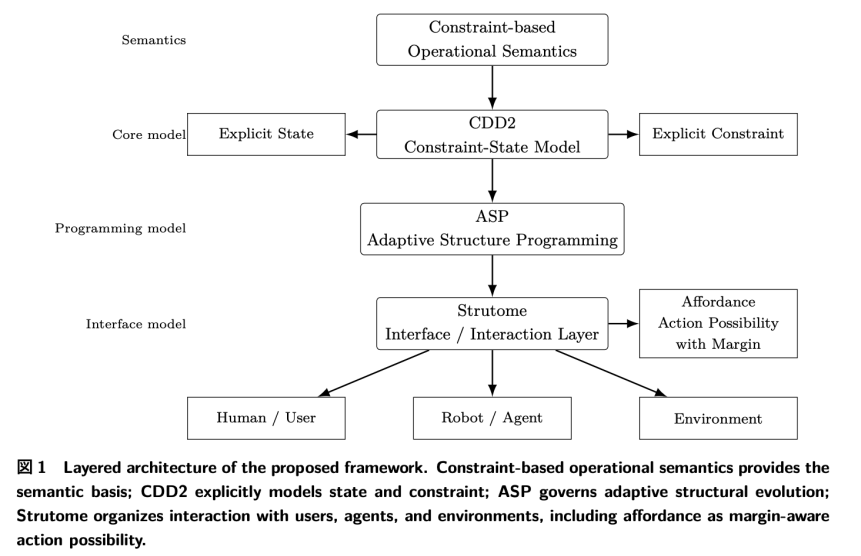
Constraint Architecture represents a layered conceptual framework in which constraints provide the structural basis of system design. Figure [fig:framework_architecture] illustrates the architecture of the proposed framework.
The figure illustrates how constraint-based operational semantics forms the conceptual foundation. On top of this foundation lies the constraint–state model (CDD2), which explicitly represents both states and constraints. Adaptive Structure Programming (ASP) governs the dynamic evolution of system structures, while the Strutome layer organizes interactions among users, agents, and environments. Affordances represent possible actions within constrained margins.
Traditional operational semantics describes computation in terms of state transitions. In such frameworks, program execution can be represented as
\[state \rightarrow state'\]
where each step corresponds to the application of an operational rule. Constraint-based operational semantics extends this model by introducing explicit constraints that regulate transitions:
\[(state, constraint) \rightarrow state'\]
In this view, constraints become integral components of the semantic model rather than external validation rules.
CDD2 extends conventional constraint-driven development by explicitly representing system states together with their governing constraints. Traditional systems often implicitly assume constraints within processing steps. CDD2 instead formalizes them as first-class elements of the system model.
The computational pattern therefore evolves from
\[data \rightarrow processing \rightarrow result\]
to
\[(state, constraint) \rightarrow transition \rightarrow new\ state.\]
This explicit representation allows constraints to participate directly in the determination of system behavior.
Adaptive Structure Programming introduces the idea that system structures may evolve dynamically under constraint conditions. Traditional architectures assume fixed structural configurations that process incoming data streams. ASP instead treats structure itself as an adaptive entity.
Conceptually, the computational process becomes
\[constraints \rightarrow structure \rightarrow behavior.\]
This formulation allows architectures to adapt as constraint relations change.
Strutome represents the structural layer that mediates interactions between internal system models and external entities such as users, agents, and environments. Unlike conventional interfaces that merely transmit information, Strutome organizes interactions according to constraint relations.
The classical interface model may be summarized as
\[input \rightarrow processing \rightarrow output.\]
Strutome introduces a constraint-oriented interaction model in which external actions are interpreted within structured constraint contexts.
Affordances represent possible actions available to agents within constrained environments. Rather than representing single deterministic actions, affordances describe ranges of viable actions that satisfy constraints within certain margins.
Within the proposed framework, affordances play an important role in enabling exploration and adaptation. They allow systems to operate not only within strict constraint boundaries but also within permissible margins that support trial-and-error processes.
This section elaborates the conceptual development from conventional systems to the constraint–state model.
Many existing computational systems follow the traditional processing pipeline:
\[data \rightarrow processing \rightarrow result.\]
In this paradigm, constraints are often implicit within algorithms or validation procedures. They rarely appear as explicit elements of the system architecture.
Constraint-Driven Development introduces constraints as design considerations influencing system architecture. Constraints guide the selection of architectural patterns, such as event-driven systems or microservice architectures.
The design relationship may therefore be expressed as
\[constraints \rightarrow architectural\ choices.\]
However, constraints remain external to the computational state model.
CDD2 extends this concept by integrating constraints directly into the system state model. Instead of influencing architecture only during design, constraints become components of the runtime representation.
The system therefore evolves according to
\[(state, constraint) \rightarrow transition \rightarrow state'.\]
From an architectural viewpoint, CDD2 shifts the focus from designing structures that satisfy constraints to deriving structures from constraints. Instead of beginning with architecture and enforcing constraints afterward, the architecture itself becomes a manifestation of constraint relations.
From the user perspective, the explicit representation of constraints provides greater transparency and predictability. Users can understand not only the outputs of the system but also the constraints governing system behavior. This improves explainability and supports controlled adaptation.
Strutome introduces a structured interaction layer that connects internal system models with external entities.
Traditional interfaces primarily transmit information between system components and users. They generally follow the simple pattern
\[input \rightarrow processing \rightarrow output.\]
Although widely used, such interfaces rarely incorporate explicit representations of constraints governing interactions.
Strutome extends this concept by organizing interactions according to constraint relations. Instead of treating external inputs as arbitrary data streams, interactions are interpreted within structured constraint contexts.
The Strutome layer plays a crucial role in mediating relationships among internal models, human users, autonomous agents, and environmental factors. By representing these relationships structurally, systems can maintain coherent behavior even when interacting with complex external environments.
Affordances introduce the concept of action possibilities within constraint margins. In many adaptive systems, strict constraints alone are insufficient; agents must be able to explore possible actions within safe margins. Affordances therefore provide the semantic foundation for trial-and-error processes that support learning and adaptation.
Operational semantics traditionally models computation as sequences of state transitions:
\[state \rightarrow state'.\]
While effective for describing deterministic computations, this model does not explicitly represent constraints governing transitions.
Constraint-based operational semantics extends this model by incorporating constraints into transition rules:
\[(state, constraint) \rightarrow state'.\]
This extension allows semantic rules to reflect constraint relations directly.
An important aspect of constraint-based semantics is the treatment of affordances. Within constraint margins, systems may explore possible actions in order to discover viable transitions. Trial-and-error processes therefore become legitimate semantic operations.
This paper has introduced the concept of Constraint Architecture, a framework in which system structures emerge from explicit constraint relations. By integrating constraint–state models, adaptive structural programming, structured interaction layers, and extended operational semantics, the framework provides a unified approach to designing adaptive systems.
Rather than treating constraints as secondary restrictions imposed upon pre-existing structures, Constraint Architecture positions constraints as primary determinants of system structure and behavior. This shift opens new possibilities for designing systems that integrate software, artificial intelligence, and robotics within a coherent constraint-centered paradigm.
The previous sections introduced Constraint Architecture as a framework in which system structure emerges from explicitly represented constraints. The discussion primarily focused on knowledge-oriented systems, particularly Retrieval-Augmented Generation (RAG), where constraints determine how information is selected and interpreted. This appendix extends the discussion by introducing the notion of Cognitive RAG, an architectural extension in which constraint-based knowledge selection participates directly in cognitive processes such as dialogue understanding and action decision.
In conventional RAG systems, retrieval primarily supports answer generation. In contrast, Cognitive RAG treats retrieval not merely as a support for text generation but as a mechanism for reconstructing the informational conditions under which decisions or responses become valid. In this sense, Cognitive RAG functions as a constraint-mediated cognitive layer connecting knowledge, interpretation, and action.
Within the Constraint Architecture framework described in the main text, Cognitive RAG can be understood as operating across several architectural layers. In particular, it connects the following components:
the Constraint Interpreter, which determines the interpretive space of a query or situation,
the Constraint-aware Retrieval mechanism, which selects knowledge sources consistent with those constraints,
the Evidence Structuring layer, which organizes retrieved information into structured relations such as claims, evidence, exceptions, and priorities,
and the Constraint-based Validation stage, which ensures that the resulting response or decision is consistent with governing constraints.
Cognitive RAG extends this architecture by allowing the retrieved evidence structure to participate not only in answer generation but also in reasoning about interaction and action. In other words, the system does not merely answer questions about knowledge but uses retrieved knowledge to determine what actions are possible or appropriate in a given context.
This architectural interpretation is consistent with the principle of Constraint Architecture discussed in the main text:
\[constraints \rightarrow architecture\]
Here constraints do not merely regulate behavior but shape the structure through which knowledge is interpreted and decisions are produced. Cognitive RAG therefore represents an operational realization of this principle within knowledge-driven AI systems.
From the perspective of operational semantics, Cognitive RAG can be interpreted as an extension of state-transition models. Classical operational semantics typically describes computation as
\[state \rightarrow state'\]
where transitions are determined by operational rules. Constraint-based operational semantics extends this formulation by incorporating explicit constraints:
\[(state, constraint) \rightarrow state'\]
Cognitive RAG introduces an additional step in which the constraint context determines which knowledge fragments participate in the transition. This can be informally represented as
\[(state, constraint) \rightarrow evidence\ structure \rightarrow state'\]
In this formulation, the retrieved evidence structure acts as an intermediate representation linking knowledge retrieval and state transition. This interpretation aligns Cognitive RAG with the constraint-centered semantic model described earlier in the paper.
To illustrate the idea of Cognitive RAG, consider a conversational AI system deployed in an enterprise environment. The system has access to multiple knowledge sources such as contracts, corporate policies, FAQs, and operational notes.
Suppose a user asks the following question:
Q: Can this contract be terminated early?
Relevant information may be distributed across multiple documents:
contract.pdf: termination requires 30 days written notice.
policy.pdf: contractual clauses take precedence over operational guidelines.
faq.pdf: in practice some teams allow shorter notice periods.
memo.pdf: emergency termination may be permitted in exceptional cases.
In a conventional RAG system, the retrieved fragments may be summarized without explicit interpretation of their relationships. The resulting answer may simply list multiple possibilities, leaving ambiguity regarding which rule is authoritative.
In a Cognitive RAG architecture, however, the system first interprets the constraint context of the question. The question is recognized as a contractual interpretation problem. Accordingly, the constraint model determines the priority structure among knowledge sources. For example, contractual clauses may be treated as primary evidence, policies as interpretive rules, and FAQs or memos as supplementary information.
The retrieved evidence is then structured into a hierarchy:
Claim: contract clause requires 30 days notice.
Exception: emergency termination described in operational memo.
Priority rule: contract clauses override operational practices.
Based on this structured evidence, the system may produce an answer such as:
According to the contract clause, termination requires 30 days written notice. Operational notes describe emergency exceptions, but the contract clause remains the governing rule unless a specific exception applies.
The key difference is that the response reflects the constraint structure governing the knowledge rather than merely summarizing retrieved text fragments.
Cognitive RAG becomes even more significant when knowledge retrieval informs action decisions. Consider an AI assistant used in operational support within an organization, where the system must determine whether a particular action is permitted.
Suppose the system receives the following request:
User: Should we proceed with immediate contract termination for this client?
This question does not merely request information; it requires a decision regarding a possible action. Relevant knowledge may again be distributed across multiple sources:
contract.pdf: termination requires 30 days written notice.
policy.pdf: legal department approval required for early termination.
memo.pdf: emergency termination permitted for severe compliance violations.
In this situation, the system must determine which actions are viable. Within the Cognitive RAG architecture, the retrieved knowledge is structured into an affordance space. In other words, the system identifies actions that are permitted, prohibited, or conditionally available under the given constraints.
The resulting interpretation may take the following form:
Permitted action: termination with 30-day notice.
Conditional action: immediate termination if compliance violation is confirmed and legal approval obtained.
Prohibited action: immediate termination without legal review.
This structured representation allows the system to respond in a way that directly informs decision-making:
Immediate termination is not permitted under standard contract conditions. However, if a compliance violation is confirmed and legal approval is obtained, an emergency termination may be possible.
Here Cognitive RAG does not merely retrieve information; it reconstructs the set of possible actions consistent with organizational constraints. In this sense, the retrieved knowledge functions as a constraint-governed affordance map.
These examples illustrate that Cognitive RAG extends the role of retrieval beyond information access. In Constraint Architecture terms, it functions as a mechanism for reconstructing the informational structure required for interpretation and action.
In conversational contexts, Cognitive RAG organizes knowledge into structured evidence that supports explanation and interpretation. In action-oriented contexts, it organizes knowledge into affordance structures that define the space of permissible actions.
Both cases demonstrate the same architectural principle: constraints determine not only how knowledge is filtered but also how knowledge participates in reasoning and decision-making.
Cognitive RAG can therefore be understood as an architectural extension of constraint-centered knowledge systems. Rather than treating retrieval as a peripheral step preceding generation, Cognitive RAG integrates retrieval into the semantic process by which states, interpretations, and actions are determined.
Within the broader framework of Constraint Architecture, Cognitive RAG illustrates how constraint-based knowledge organization can support both dialogue understanding and action decision. This perspective suggests that retrieval systems in advanced AI architectures should be viewed not merely as search mechanisms but as components of a constraint-governed cognitive infrastructure.